
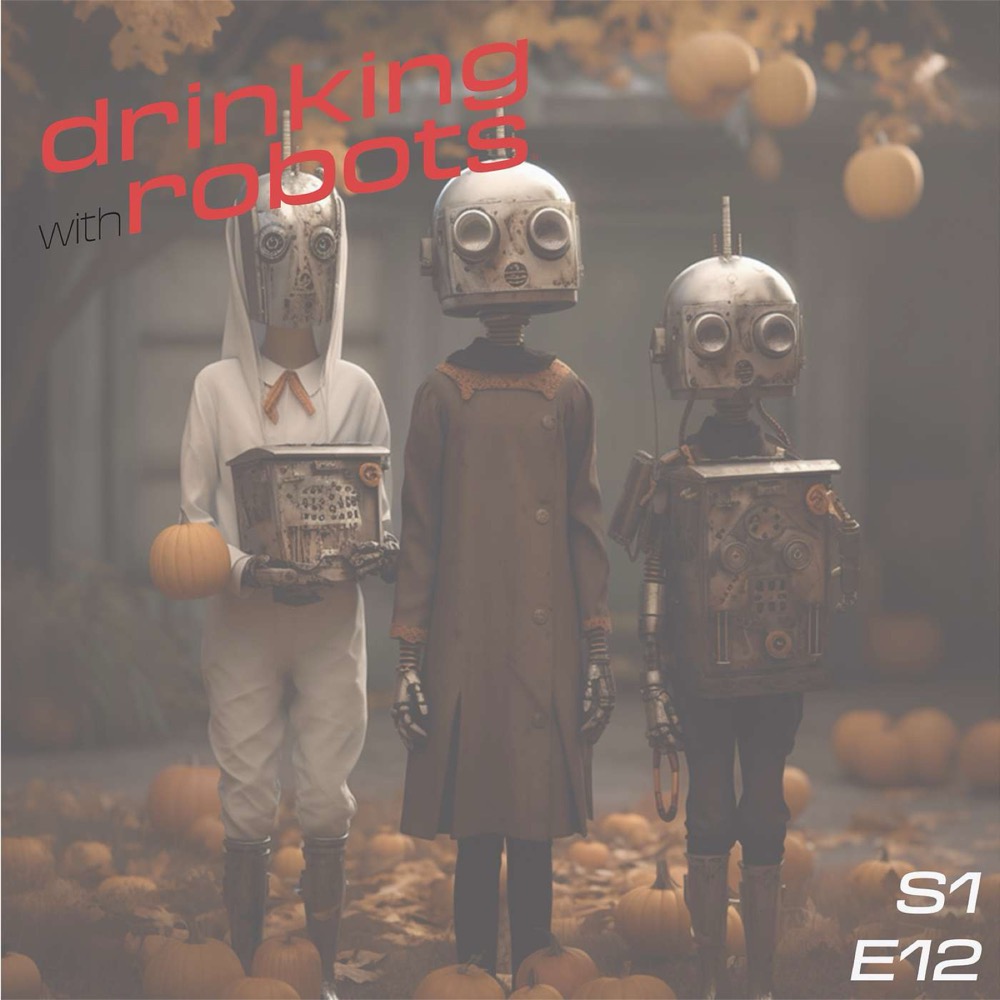
We recorded our Halloween episode on Friday the 13th, which felt about right. Rob grew up without much money in western North Carolina, and most of his childhood costumes came out of his parents’ closet. In the lean years he went as a sheet. Our guest, Brianna Neville, grew up in Massachusetts, where you went to the nice neighborhoods because that’s where they gave out the full-size bars. Both of those Halloweens come from a holiday that is a lot older and a lot stranger than either of us knew.
It starts with Samhain
Samhain (say it “SOW-in,” and don’t ask us to explain Irish spelling) was the Gaelic festival marking the end of the harvest and the start of winter. It fell on November 1 and the night before. It was one of four seasonal festivals in the old Irish calendar, along with Imbolc at the start of February, Bealtaine in May, and Lughnasa in August. Some Neolithic passage tombs in Ireland, including the Mound of the Hostages on the Hill of Tara, are lined up with the sunrise around Samhain, so people were marking this point in the year long before anyone wrote about it.
In Irish mythology, Samhain is a night when the boundary between this world and the Otherworld wears thin and things cross over. Bonfires were lit, and people went around in disguise. How much of the modern “night of the dead” idea is truly ancient is still argued over. Ronald Hutton, who wrote the standard history of the British ritual year, doubts Samhain was especially about the dead at all. But the spooky reputation stuck.
All Hallows’ Eve
Christianity put its own holidays on the same dates. By around the year 800, churches in Ireland and in Northumbria were celebrating all the saints on November 1, and the Frankish Empire made that date official in 835. All Souls’ Day on November 2 spread in the 1100s. October 31 became All Hallows’ Eve, and eventually Halloween.
Two customs from that era still shape the holiday. In souling, poor people went door to door collecting soul cakes in exchange for praying for the household’s dead. It’s recorded in England from at least the 1400s. In guising, people in costume went house to house reciting verses or singing for food, recorded in Ireland and Scotland from the 1500s. Brianna, whose family is third-generation Irish, pointed out the part that got lost: the night was also for talking to your dead and catching them up on how the family’s year had gone. She compared it to Día de los Muertos.
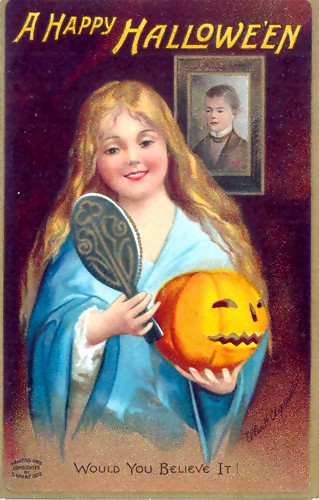
It was a night for fortune-telling too. You could peel an apple in one long strip and toss the peel over your shoulder to see the initial of the person you’d marry. Or you could sit in front of a mirror in a dark room and hope his face showed up behind yours, as the girl on the postcard is doing. That mirror ritual is the likely ancestor of the Bloody Mary game, which we dig into in our Bloody Mary post.
Turnips first, pumpkins later
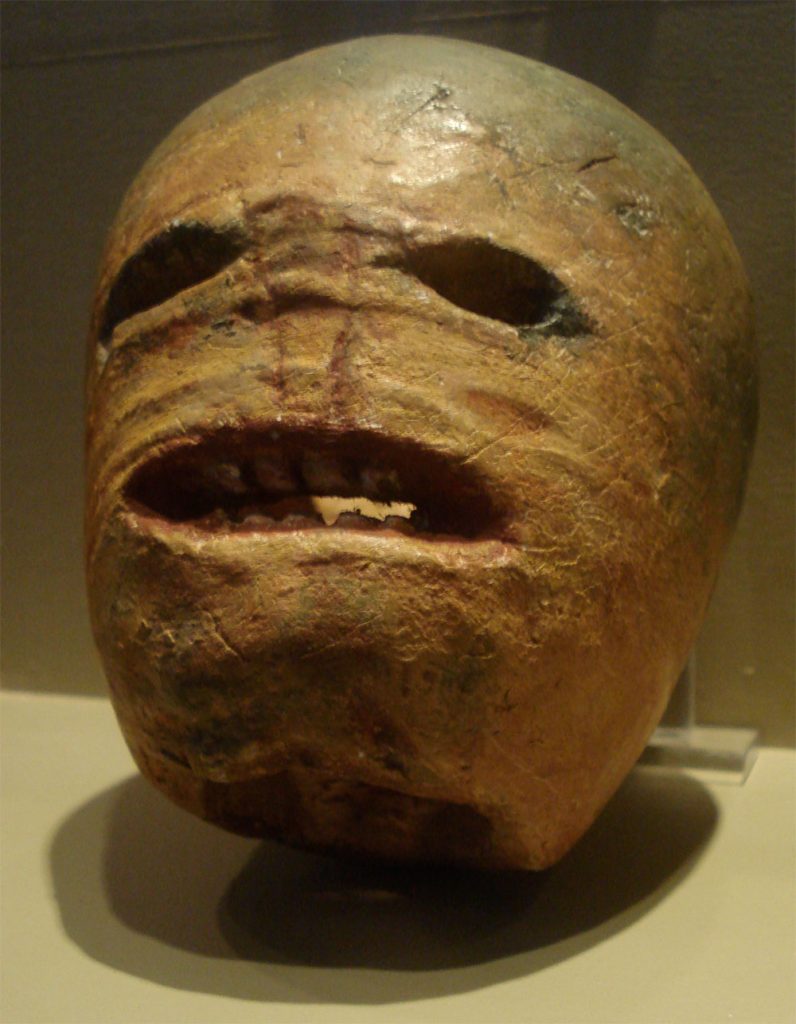
The first jack-o’-lanterns were turnips. In Ireland, Scotland, and northern England, people hollowed out turnips or mangel-wurzels, carved faces into them, and put a light inside. The one pictured above is about a hundred years old, and it’s a lot scarier than anything on your neighbor’s porch.
The name comes from the Irish folktale of Stingy Jack, a drunk who tricked the Devil twice. When he died, heaven wouldn’t take him and neither would hell, so he wanders the dark with a coal in a carved turnip to light the way. When Irish and Scottish immigrants got to North America, they found pumpkins, which are bigger and much easier to carve. Americans were carving pumpkins by 1837.
How Halloween came to America
Colonial New England had little interest in Halloween. The Puritans had no use for a holiday with Catholic roots, though autumn “play parties” with harvest food, dancing, and ghost stories did some of the same work. The big change came in the 1840s, when the potato famine sent huge numbers of Irish immigrants to the United States, and their customs came with them.
By the late 1800s, Halloween was becoming a party holiday, with games, seasonal food, and costumes. Trick-or-treating took longer. The earliest known use of “trick or treat” in print is in a 1917 newspaper from Sault Ste. Marie, Ontario, and the practice spread across the US in the 1930s, partly as a way to steer kids away from the pranks and vandalism that had become a Halloween problem.
Then candy companies caught on. The National Retail Federation expected Americans to spend a record $13.1 billion on Halloween in 2025, about $3.9 billion of it on candy.
And the razor blades in apples? Brianna spent years as an EMT and worked every Halloween, partly to prove a point to her mother, who inspected every piece of candy her kids brought home. She never once saw a case. She also quoted a meme: nobody likes your kids enough to give them free drugs.
What people drank
There’s no one traditional Halloween drink. Ale and mead went with harvest feasts, and apples, the fruit of the season, turned up in cider and in games like bobbing. Most of the cocktail world’s Halloween favorites earned their place by name. The Corpse Reviver family goes back to the 1800s as a morning-after cure. The No. 2, with gin, Lillet, orange liqueur, lemon, and a rinse of absinthe, was printed in Harry Craddock’s Savoy Cocktail Book in 1930. Death in the Afternoon, which is absinthe topped with Champagne, is credited to Ernest Hemingway, who contributed it to a celebrity cocktail book in 1935.
Today’s Halloween menus run on cinnamon, apple, and pumpkin, with a few drinks dyed black with activated charcoal for the photos and punch bowls with lychee-and-blueberry eyeballs floating in them. The spookier it looks on Instagram, the better.
Brianna Neville of Weldon Mills Distillery
Brianna is the general manager at Weldon Mills Distillery in Weldon, North Carolina, a bourbon distillery about 15 minutes from her home on the Virginia side of the state line. Before that, she did high-volume bartending in Myrtle Beach, which she sums up as Margaritaville on repeat on a 100-degree patio. Then she spent several years as an EMT in southern Virginia.
When Weldon Mills opened, she sent them a Facebook message saying she was a bartender looking for part-time work. The reply: come in Friday and we’ll see how you do. That Friday was the busiest night she has ever worked. Almost five years later, she runs the place.
She reads a lot of cocktail books and hunts antique shops for old ones. When she travels, she asks locals where to drink, asks the bartender there what they’d recommend, and then goes looking for a book on whatever they poured. She and Rob agree on where a beginner should start: Death & Co’s Cocktail Codex, which explains why drinks work, not just how to make them.
Her three Halloween-night movies: the original Halloween, The Exorcist, and Scream.
The challenge: your favorite Halloween candy, all grown up
We asked both competitors to turn a favorite childhood Halloween candy into a modern, grown-up cocktail. The AI tends to stumble on prompts like this one, because it has never had a favorite candy or a childhood.
Brianna picked Almond Joy, because her older brother always stole the good candy and she was the baby. Her drink starts with Weldon Mills Select bourbon (94 proof) washed with coconut oil, which gives it a silky body. She added crème de cacao from Asheville’s Cultivated Cocktails and a syrup made from NoDa Brewing’s Coco Loco coconut porter. Bars on the West Coast had been cooking beers down into syrups, and she brought the idea home. A shot of espresso tips its hat to Dick Bradsell, the London bartender who created the Espresso Martini. When we made it for judging, we used Old Forester 100 Proof because it’s easier to find, but you should go find Weldon Mills.
The AI made a Candy Corn Old Fashioned: 2 ounces of bourbon, a half ounce of candy-corn-infused simple syrup, and two dashes of orange bitters, stirred, poured over a big cube, and finished with an orange peel. The syrup comes out a vivid pumpkin orange. Brianna’s review of making it: “No one loves candy corn.” Rob, for the record, loves candy corn. Brianna called him a broken soul.
Final score: AI 74, Brianna 72. Taste was a tie at 39. Brianna won originality 18 to 13, but the AI took presentation 22 to 15, and that decided it. Our judge called Brianna’s drink “well balanced and very creative” and wished it had a garnish to break up all that rich chocolate brown. She found the AI’s drink “more balanced than expected” but “not super creative.” Lesson learned: always garnish your cocktails.
Brianna Neville's Almond Joy
Ingredients
- 2 oz coconut-oil-washed bourbon (Weldon Mills Select or Old Forester 100)
- 0.75 oz crème de cacao (Cultivated Cocktails)
- 0.25 oz coconut porter syrup
- 0.5 oz espresso
- almond bitters, to finish
Garnish
Our judge wanted one. Toasted coconut or a single almond would do it.
Instructions
- Add the bourbon, crème de cacao, porter syrup, and espresso to a shaker with ice.
- Shake hard and double strain into a chilled coupe.
- Finish with a few drops of almond bitters on top.
Notes
Coconut-washed bourbon: stir 2 oz of melted refined coconut oil into a 750 ml bottle of bourbon, let it sit a few hours at room temperature, freeze overnight, then strain the bourbon off the solid fat through a coffee filter. Coconut porter syrup: warm equal parts porter and sugar until the sugar dissolves without boiling hard.
Listen to the episode
“My brother stole all the good Halloween candy with Brianna Neville” is Season 1, Episode 12 of Drinking With Robots. Listen above, on Buzzsprout, or wherever you get your podcasts.
Follow Weldon Mills at @weldon.mills. For more on the espresso side of Brianna’s drink, read our history of espresso, and for another bourbon story, The Evolution of Whiskey.
This episode was sponsored by Remedy Cocktail Company, makers of handcrafted cocktail bitters.